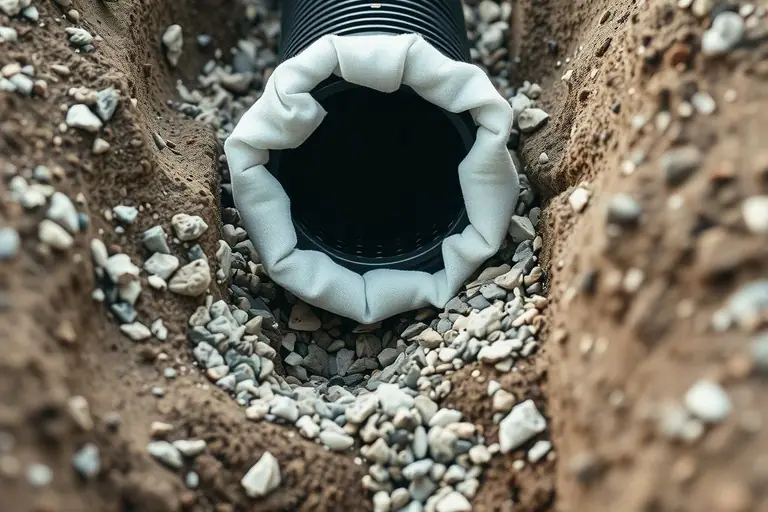
Step by step
- Find the water and the outlet. The route starts where water collects and ends where it can leave safely: daylight, a curb or storm connection where allowed, a dry well or a pump.
- Mark utilities. California requires at least two working days' notice through 811 before digging (USA North 811). Irrigation and low-voltage lighting aren't marked; the contractor should locate those too.
- Dig the trench with a steady fall. NDS recommends at least a 1% drop, 2% for corrugated pipe (NDS). Depth runs from under 2 feet for shallow yard drains to 3 feet or more on hillsides (Cardona).
- Line the trench with filter fabric so fine soil stays out of the rock.
- Bed and lay the pipe. Perforated pipe, commonly 4-inch for homes (NDS), on a layer of washed rock, checked for fall along the run.
- Add cleanouts at the upper end and at turns so the line can be flushed and camera-inspected.
- Cover with rock and close the fabric over the top.
- Cap and restore. Topsoil and sod, mulch, or decorative rock at the surface; irrigation and hardscape repaired.
- Test it. Run a hose into the upper end or cleanout and confirm water reaches the outlet.
Timeline
Most residential French drains take one to a few days. Hand digging on slopes, rock, concrete cutting and long restoration add time.
How to prepare
- Mark sprinkler lines, low-voltage lighting and anything buried that 811 won't mark.
- Move furniture, pots and vehicles out of the work path.
- Confirm HOA approval if your community requires it.
- Agree on where soil will be staged and how lawn and plants will be protected.
How to spot a bad install
- No filter fabric, or fabric only under the rock.
- No defined outlet, or an outlet buried under mulch.
- Roof downspouts connected straight into the perforated pipe.
- No cleanouts on a long run.
- Pipe that wasn't checked for fall, leaving sags.
DIY or hire a pro?
A short, shallow run on a flat yard with an obvious outlet is a reasonable DIY project for some homeowners. Long runs, deep trenches, slopes, work near trees or foundations, and anything connecting to the street are better left to a licensed contractor. See how to choose one and the cost guide.
Questions homeowners ask
How deep should a French drain be?
It depends on the problem. The pipe maker NDS says about 8 inches to 2 feet is enough for many water-diverting projects (NDS). One Bay Area contractor describes shallow yard drains at 18–24 inches, foundation-grade drains at 24–36 inches or more, and hillside drains at 36 inches or more (Cardona Construction).
How much slope does a French drain need?
NDS recommends at least a 1% drop toward the outlet (about 1 foot per 100 feet) and 2% for corrugated pipe (NDS).
Do I have to call 811 before digging a French drain?
Yes. California requires at least two working days' notice before excavation, and that includes homeowners (USA North 811). Dial 811 or file online.