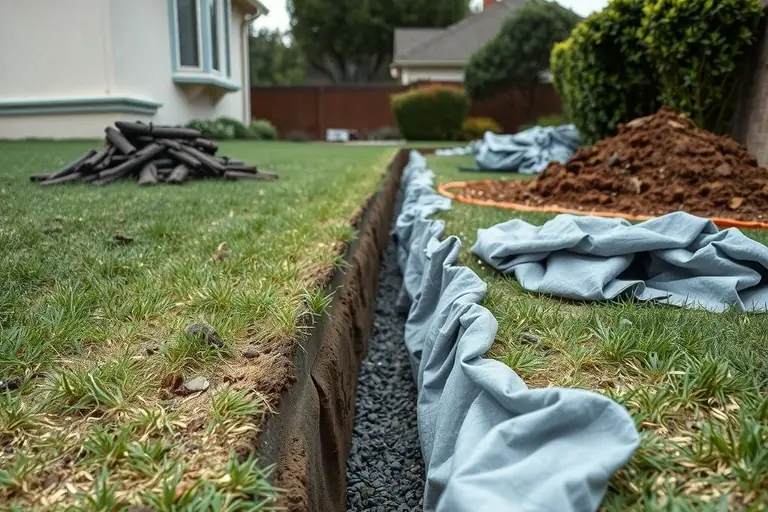
Is a French drain the right fix for your yard?
Run through this before getting quotes. If most answers point to surface water, start with downspouts and catch basins or regrading instead.
- The ground stays soft or squishy a day or more after rain stops.
- Water seeps out along a wall, slab edge or the bottom of a slope.
- Puddles return in the same place even though downspouts empty well away from the area.
- There is somewhere downhill for the water to go: a curb outlet, storm connection, dry well or a safe daylight point.
If water comes from uphill on a slope, the fix is usually an interceptor drain across the slope; see hillside and slope drainage.
Common layouts
| Layout | Where it goes | Used for |
|---|---|---|
| Yard (field) drain | Through the wet area of a lawn or planting bed | Soggy lawns and low spots fed by groundwater |
| Foundation perimeter | Along the outside of the foundation, below the slab or footing level the contractor specifies | Seepage against walls, damp crawl spaces fed from outside |
| Curtain / interceptor | Across a slope, uphill of what you want to protect | Water moving down a hillside toward the house |
| Behind a retaining wall | At the base of the wall backfill | Relieving water pressure behind walls (part of wall design) |
What goes in the trench
- Perforated pipe, commonly 4-inch for homes, laid on a bed of rock (NDS).
- Washed drain rock around and over the pipe, so water reaches it easily.
- Filter fabric wrapping the rock to keep fine soil from clogging it.
- Fall to the outlet. The manufacturer NDS recommends at least a 1% drop, and 2% for corrugated pipe. Depth, fall and outlet are explained in how a French drain is installed.
- Cleanouts at turns or ends so the line can be flushed or camera-inspected later.
Where the water goes: outlet options
| Outlet | Good fit | Watch for |
|---|---|---|
| Daylight at a lower part of the lot | Sloped lots with room downhill | Must not create erosion or send water onto a neighbor |
| Curb outlet or storm connection | Flat lots near the street | City rules and permits vary; ask your city public works |
| Dry well | Soils that absorb water | Dense clay or shallow rock may not take the water |
| Sump and pump | No downhill route at all | Needs power, maintenance and a place to discharge |
An outlet that backs up turns a French drain into an underground puddle. A good quote names the outlet and shows the route.
What it costs
Bay Area French drains run roughly $35–$90+ per linear foot, more for deep hillside work. The cost guide has worked examples for 50, 100 and 200 feet.
Timeline and disruption
Expect a trench through lawn or beds, soil piled on tarps or plywood, and a few days of work for a typical yard. Ask how lawn, irrigation lines, pavers and plantings will be restored and who pays for it. Concrete cutting and patching costs extra.
Trees, utilities and permits
- Call 811 first. California requires at least two working days' notice before excavation so utilities can mark their lines (USA North 811). The contractor usually files the ticket.
- Protected trees. Every city here protects certain trees, and trenching through roots can count as damage. Walnut Creek, for example, highly protects native oaks (Walnut Creek tree ordinance). Route the line around the root zone or ask about an arborist.
- Permits. A simple yard drain often needs none, but grading, a street or storm connection, or work near a creek can. Ask the contractor who will check and pull permits.
Questions homeowners ask
How much does it cost to install 100 feet of French drain?
At the Bay Area rate of about $35–$90+ per linear foot, 100 feet works out to roughly $3,500–$9,000+ (Cardona Construction). National guides quote less ($1,000–$3,500+ for 100 feet of shallow exterior drain, HomeGuide), but they assume easier digging than most hillside lots here. See the cost guide.
Are French drains worth the money?
When the problem is water in the soil, yes: a well-built French drain with a real outlet can work for decades. When the problem is surface water from roofs or bad grade, a French drain is often the wrong (or only partial) fix. Read French drain pros and cons first.
Should a French drain go inside or outside the crawl space?
Most yard and foundation-perimeter drains go outside, intercepting water before it reaches the house. Water already getting into a crawl space may need an interior system and a sump, which is closer to foundation or waterproofing work. Ask the contractor to explain why they recommend one or the other.
How long does installation take?
A typical residential French drain takes one to a few days. Long runs, hand digging on slopes, concrete cutting, rock removal and restoration add time.