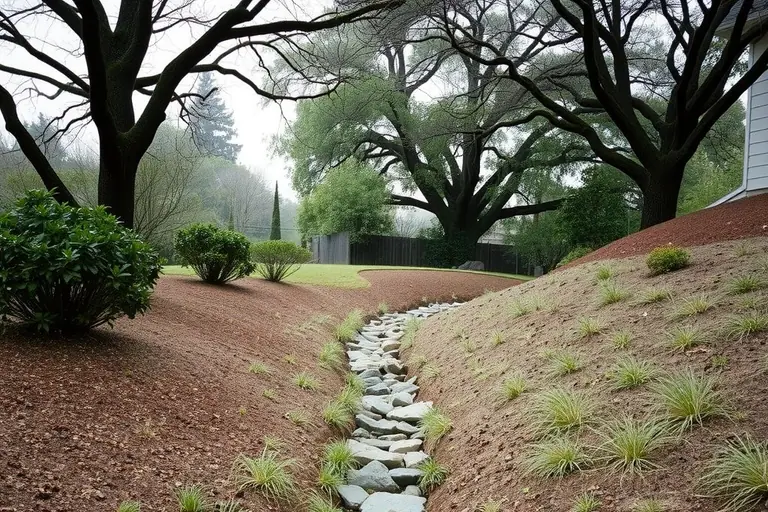
Why hillside lots here hold so much water
Rain here comes in a few months. Concord's long-term normals show about 16 inches a year, roughly 3.2 inches in each of December, January and February (NOAA normals). In a long storm, the hillside soaks up water, and shallow groundwater moves downslope until it hits a cut, a patio, a retaining wall or the house.
The USGS studied damaging landslides in Contra Costa County between 1950 and 1971 and found that most occurred on ancient landslide deposits and were set off by long storms, typically those delivering more than about 7 inches of rain (USGS Bulletin 1388). You can check whether your lot is in a mapped landslide zone with the California Geological Survey EQ Zapp tool.
What each fix does
| Problem | Usual fix | What it involves |
|---|---|---|
| Water sheets down the slope in storms | Swale or berm above the house | Shaped, often rock-lined channel that carries runoff around the house to an outlet |
| Wet strip or seep at the bottom of the slope | Interceptor (curtain) drain | Rock-and-pipe trench across the slope, uphill of the wet area |
| Water behind a retaining wall | Wall back-drainage | Rock and pipe behind the wall, weep holes or outlets; part of wall design |
| Erosion and gullies on bare soil | Surface control plus planting | Redirect concentrated water first, then stabilize with plants or erosion fabric |
| Downspouts discharging onto the slope | Solid pipe to a safe outlet | Roof water piped past the slope rather than dumped on it |
| Outlet causing erosion downhill | Energy dissipater | Rock apron or splash pad that slows water where it leaves the pipe |
For flat yards and foundation seepage, the French drain installation page covers layouts and outlets.
Retaining walls and drainage
Most retaining-wall failures involve water. A wall needs drainage behind it, and the slope above it needs runoff kept off the backfill. If a wall is leaning, bulging or cracked, that is a wall and engineering question first; drainage is part of the repair, not the whole answer.
Drainage contractor or engineer?
| What you see | Start with |
|---|---|
| Puddles, soggy ground, runoff, erosion of topsoil | Drainage contractor |
| Seeps at the base of the slope, water behind a sound wall | Drainage contractor |
| New cracks in the ground, driveway or patio | Geotechnical engineer, then contractor |
| Tilting retaining walls, fences, trees or poles | Geotechnical engineer, then contractor |
| Doors or windows that suddenly stick after storms | Geotechnical or structural engineer |
| Bulging soil at the toe of the slope | Geotechnical engineer, and contact your city or the County |
The hillside warning signs guide explains each sign and what to do during a storm.
Permits on slopes
Grading, large cuts and fills, retaining walls and work near creeks often need permits and sometimes engineered plans. Walnut Creek and Danville run their own building departments; Lafayette and Moraga use Contra Costa County for building inspection, and unincorporated Alamo, Blackhawk and Diablo are under the County (County permit overview). Ask your contractor who checks and pulls permits before work starts.
What drives cost on a slope
Hand digging where machines can't reach, deeper trenches, rock, hauling soil up or down stairs, engineering and permits, and restoring plantings. One Bay Area contractor puts deep hillside subsurface drains at $75–$100+ per linear foot (Cardona Construction). See the cost guide for examples.
Questions homeowners ask
What is the best drainage for a sloped backyard?
Usually a combination: an interceptor (curtain) drain across the slope to catch water moving downhill, a shaped swale to carry surface runoff around the house, downspouts piped to a safe outlet, and plants or other erosion control on bare soil. Which parts you need depends on where the water comes from and how steep the lot is.
How do you stop water running down a hill into your yard?
Catch it above the area you want to protect. A swale or berm handles surface runoff; an interceptor drain catches shallow groundwater. Both need an outlet that can take the water without causing erosion further down.
Can I redirect water onto my neighbor's property?
Don't plan on it. Changing where water leaves your lot can create legal and neighbor problems. Talk to your contractor, your city or the County about approved outlets, and get legal advice for disputes. This site doesn't give legal advice.
When do I need an engineer instead of a drainage contractor?
When the ground itself is moving or the work is structural: new cracks in soil or pavement, tilting walls or fences, doors that suddenly stick, a bulging slope, or large grading and retaining walls. A geotechnical or civil engineer assesses the slope; a drainage contractor then builds the water-management part of the plan.